What is authenticity

We see this word so often now, but what does it really mean?

Authenticity is when your actions are congruent with your beliefs and values, irrespective of what pressures may be applied.

To be authentic, it is not enough to know your values, you must be your values.

Brene’ Brown describes it as “a collection of choices that we have to make every day. It’s about the choice to show up and be real. The choice to be honest. The choice to let our true selves be seen.”

What does your business actually do?

Ask someone what their business does and you’ll usually get an answer about products or services.

  • “We sell tyres.”
  • “We provide accounting services.”
  • “We manufacture widgets.”

All perfectly accurate but it completely misses the bigger picture.

One of the questions that changed my thinking about business was:

What difference does your organisation make to the communities you serve? (Steve Bowman, Conscious Governance)

This question can take you somewhere quite different.

  • Maybe you don’t sell tyres. Maybe you help families stay safe on the road.
  • Maybe you don’t provide accounting services. Maybe you give small business owners the confidence to make better decisions.
  • Maybe you don’t manufacture widgets. Maybe… well, I’ll leave the widgets to you.

The important thing is that changing the question changes the conversation. Once we start thinking about the outcome we create rather than simply the transaction we make, different opportunities begin to appear.

It changes how we talk about our business.

It can change who we partner with.

It can influence what we buy, who we employ and where we put our time and resources.

Most importantly, it gives people something bigger to connect with. Remember business is between people and this gives others a chance to engage at more than just a transactional level. Fundamentally, we all want some connection to those we transact with.

Sometimes it begins with a very simple question.

What difference do we make?

You might be surprised where the answer takes you.

It should be simple

We know we should keep it simple. Even the Roman Emperor Marcus Aurelius said “Ask yourself at every moment – is this necessary?”

Knowing it and doing it are two different things though.

Had a great coffee catch up yesterday with a team who have been successful for well over 15 years using a very simple business model. It’s not sexy, it doesn’t glitter like gold and it’s a business that will never be listed on the NZX. But it works, and it works well.

When they’ve found things getting hard, wheels spinning and everyone is head down in detail, going back to a simple core model has reset what they’re doing.

Even the very best organisations need to take that step back and just check it. When life seems unproductive and being busy isn’t resulting in more returns, ask yourself “are we only doing what matters?”.

Whether you’re striving for profit or there for community outcomes, remember that complexity is the trap that can lead you astray.

It is who I am

Lately I’ve taken the unusual step of adding humorous memes to some of my posts on LinkedIn (generally involving coffee). Now I understand that some people may see these as more suited to Facebook than LinkedIn. After all, LinkedIn is a serious, professional platform. 

  • This is a deliberate move on my part, with some “professional” thinking behind it.
  • It is completely normal to be able to have a laugh within a professional environment
  • Humour, at the right time, can be a very powerful leadership tool

Sometimes life is too serious not laugh at

For me though, I have chosen to odd the occasional funny meme for one very important reason. Authenticity. I am professional and I take things seriously – but I will always see something to lighten the mood. 

I may be an introvert but I will crack a joke. That is who I am

The old bloke is going high tech…

Really looking forward to starting the AI for Charities course tomorrow.

Up until now I haven’t paid too much attention to how AI can be used in the sector, mainly because writing, thinking and researching are things I enjoy doing. Now it’s time to broaden my horizons…and become young again (well that’s my plan)

It’s not complicated

  • We all know that leadership can be lonely, especially in small to medium sized organisations. 
  • We’re not perfect, we all have weaknesses. 
  • Innovation is great, but there are no rules or history.
  • Who is responsible for keeping our passion alive when we’re knee deep in accounts payable?

A sounding board is a relatively new concept  but it makes a lot of sense. It gives you the opportunity to slow down, think clearly and ultimately make better decisions. 

No judgement. No being sold to. Simply helping you to work things through.

Find out what a sounding board can do for you david@theoptimisticcynic.co.nz

Think S for Growth

I’m no academic nor an economist but I do understand how some models and theories can be used to illustrate real world issues.

So much advice is around saying that leaders need to work on their business, not just in it. LinkedIn is full of this mantra. Are we doing this though, and if so, what exactly are we thinking about?

Lately I have seen numerous examples where apparently successful organisations haven’t taken that step back to consider what lies ahead. What infrastructure needs are coming up, how much growth do we have, is it time to pivot? Basic questions but ones we need to answer. 

Now before those in the for purpose space switch off thinking this is some sort of capitalist crusade, think again. Most of the examples I’ve seen lately are within your area. Small, local voluntary ones as well as large national organisations.

So things are looking good? 

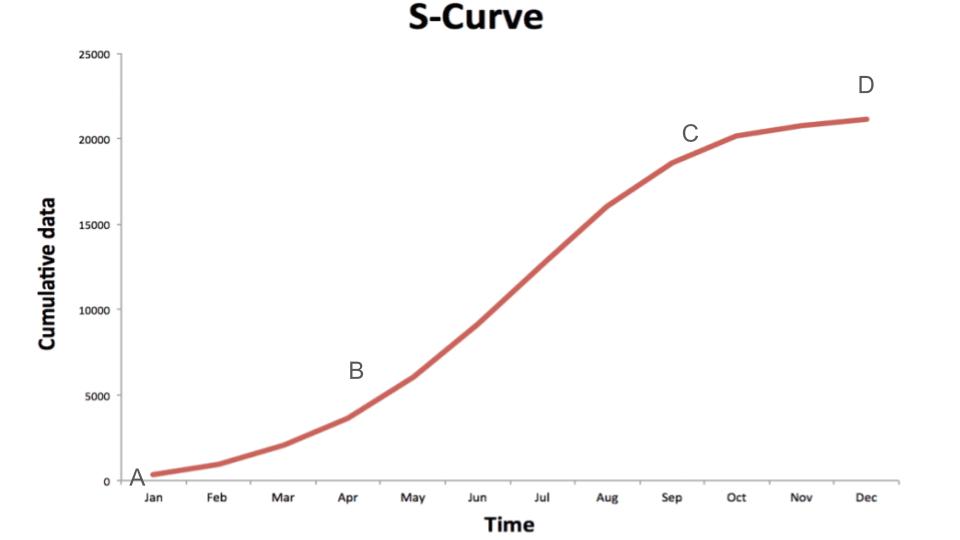
Excellent, now let me introduce you to my friend the S curve. This squiggly line is a great tool for strategic thinking, and best of all, you don’t really have to worry about the numbers on it.

This curve is used in many ways but at its heart, it’s a very simple concept. It’s all about growth. When you start off, your growth is usually slow, whether it is sales, clients, members or people supported (A). Growth then picks up and the graph shoots upwards (B). Sooner or later though, your growth will start to slow down as new sales or people become harder to find or engage with (C). Eventually most things finish growing and then you can start to lose business (D). Newer products or services come into the market and your client base starts to move on. This is normal and generic. An organisation’s longevity often relies on bringing onboard new “s”. 

Of course the speed, size and length of growth vary greatly between products and organisations.

Where would you place your organisation on this graph? Forget the numbers or what the Y axis represents, just focus on the picture and pick a spot.

A

Do we see growth picking up and when do we think we’ll see a sharp upturn (or will we)?

If the growth comes, what infrastructure will we need to put in place? More staff, more administration, compliance management, new vehicles or plant?

B

How much longer will this good growth occur?

Will we need increased infrastructure, and how soon?

At what point should we be starting to look at ‘what next’?

C

Do we agree that our growth is going to plateau off?

How much time do we think we have before numbers start to decrease?

If we stay at this level or start to decrease, what are the implications on resourcing?

What can we start working on now to replace this S?

D

What new S can we introduce now?

Is our infrastructure now fit for purpose, and if so, for how long?

Do we maintain a decreasing product/service or should we be phasing it out?

Obviously this is all very simplified, but hopefully it gives you an idea about some of the things you need to think about, whatever stage of growth you’re at. There’s plenty of information out there about S curves. 

Sing out if you want to run your ideas on this topic past a sounding board, I’m happy to sense check your thinking. 

It will never be everything

I had another fantastic coffee catch up today – having been head down for three years, I really did miss these mental stimulation opportunities. One of the many topics we discussed was AI and once again I was reminded that no matter how clever it is, it definitely has limitations.

AI is really an amazing tool and the potential seems unlimited. Still, while I might marvel about what AI can do, it will never fill my cup like talking to an wonderful human being.

Sure it can draft up a good business case, but its why will never be authentically human. Agreeing and disagreeing based on values and critical thinking, the real interest in the person behind the words and lifting up from the topics to consider the ‘world’ view. These things matter.

Sure it could provide the words, but the personal touch won’t be there.

A chat I had with a CEO a while back summarised where AI can really change our lives. By removing the admin, research and systems, it will free us to meaningfully engage with each other.

Like every tool, we need to ensure AI enhances humanity, not negate it.

We need to end fragmentation

In case you didn’t notice, it’s hard out there. Increasing number of organisations applying for a smaller pool of donations. New contracts are almost unheard of while compliance is a never ending beast.

If we want a thriving charitable sector, we need to be smarter. We can’t keep on setting up new organisations in the belief that our purpose is so just that money will simply appear. It won’t.

We need genuine collaboration towards shared goals.

  • Organisational interests need to take a back seat in our drive to achieve a common purpose.
  • We need to look for partners outside of our specific sector to broaden our skills and resource base.
  • We need to collaborate bravely to break down barriers and change systems

We need to competing over funding

  • We have to accept that there will only be a certain level of funding in New Zealand. Duplicating our services simply dilutes that pool.
  • We need to recognise the potential of business in supporting shared goals. This relies on meaningful relationships not simply expecting never ending donations.
  • Working with other organisations to allow services to be delivered with economy of scale.

We need to have contentious conversations

  • There is a place for joint ventures and mergers. We need to look past our own brands and ‘local’ solutions if we want to make a significant difference to our communities.
  • Local solutions are a valid option but we still need to look for opportunities to share or leverage infrastructure. Duplicated infrastructure dilutes funding and diverts our focus from achieving our purpose.

My cup runs over…

Coffee and a chat is a great foundation for discovery and learning. A gentle 30 minute walk on a clear frosty morning makes to doubly so.

Yesterday I had the pleasure of meeting a small business owner and finding out more about her enterprise. What I loved was how simple it was and yet it ticked all the boxes.

Clearly identified customer base – one that genuinely needs the service being offered. Building a business to solve a customer’s problem…. business 101. Bonus points for the fact it is helping the community.

Fully understood her cost structure, and focused on what was profitable. Not growth for growths sake.

Listening to her, she clearly cared for her team but at the same time, you could tell there were expectations on output (quality and quantity). Call me old fashioned but isn’t this how it’s meant to be?

Talking of her team, she cleverly built the working day around school hours. There is a big pool of very talented people who are at home with kids. Tapping into this resource is smart business – and again helps out our community.

Yesterday was a day when chatting over coffee filled my cup.Activate to view larger image,